
Appomattox County Property Value Types
Property value means different numbers in Appomattox County. The assessment is one. It supports real-estate taxation. Market value estimates what a parcel might sell for under stated conditions on a given date. Deed records show a conveyance and may state consideration, though the public SRA landing page offers no searchable sale-price field.
| Value | What It Is | Where |
|---|---|---|
| Assessed value | County figure used for the real-estate tax process | Commissioner of the Revenue / CAMA |
| Fair market value | Value standard required by Virginia law for assessment | Commissioner; not a private sale appraisal |
| Sale consideration | Value or terms stated in a recorded conveyance when present | Check the deed; SRA's public landing page does not confirm a result field. |
| Land and improvements | Separate components may be relevant to review | Exact live CAMA fields were not exposed; confirm with the Commissioner. |
Virginia Code §58.1-3201 sets the standard for assessments. Real property is assessed at 100 percent of fair market value. That is a legal rule. It is not a price guarantee. The current tax roll can still drift from what a buyer would pay today. Mass appraisal works from market analysis across many parcels, and a recent sale or local condition can pull one away from the norm. A licensed appraiser gives a separate opinion for a specific purpose.
Appomattox County's Fair-Value Standard
Appomattox County starts from the Code of Virginia, which names fair market value as the assessment basis for real property. The Commissioner of the Revenue applies that framework. The statutory standard is full fair-market-value assessment. No separate ratio applies. The public CAMA notice shows the assessment date, though it does not display a full parcel card.
Treat the value as a tax record. It is not a listing recommendation or a promise of a future sale amount. Differences can come from the valuation date, condition changes, parcel configuration, or the evidence available to the county. Compare like land and improvements first. A neighbor's assessment is not automatically a match.
The governing framework appears in Virginia Code Title 58.1, Chapter 32.
Appomattox County's 2026 Reassessment
Appomattox County's 2026 reassessment rested on fieldwork and market analysis by Pearson's Appraisal Service, now part of Vision Government Solutions. The county mailed notices and posted proposed values online. A proposed figure is one step in the process. It is not a tax bill. It is not a promise of a future sale price.
Challenges go to the Board of Equalization. Land value, building value or the total can each be appealed. County materials say hearings may take place after February 1, 2026, with evidence tied to error, nonuniformity or fair market value; a separate 45-day notice waiver cites §58.1-3331. Check the county notice for timing and filing steps.
Use the county's 2026 reassessment page to review proposed values and the appeal process.
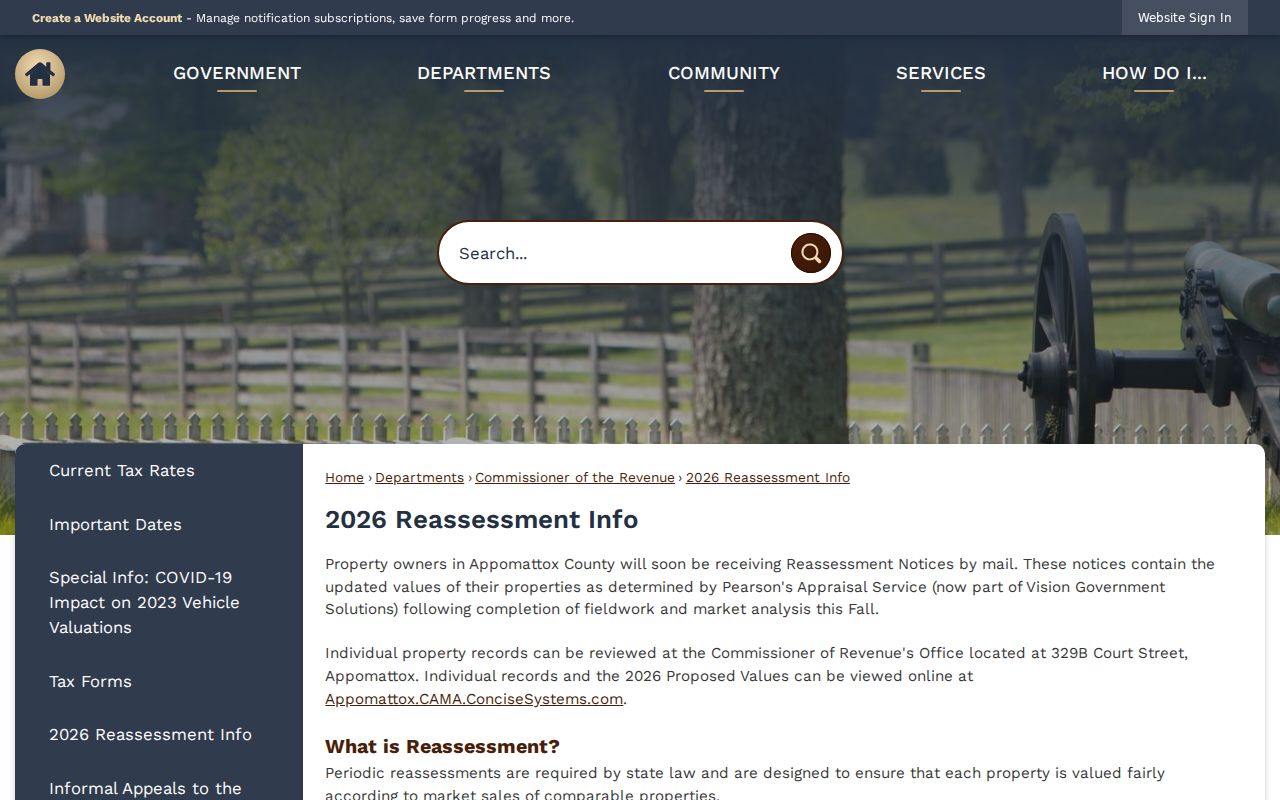
That county page handles reassessment review and appeals.
Looking Up Property Values in Appomattox County
The county's CAMA system lets anyone look up an Appomattox County assessment by address, owner name, map number, or PRN. Each record carries a January 1, 2026 effective date for both the assessment and the ownership data, so keep that date alongside any value you note down. The Commissioner's own records remain the controlling source. A parcel card missing a field on screen can be completed through the office directly.
- Search CAMA by the address, owner, map number or PRN.
- Note the assessment date and the value fields visible for that parcel.
- Use the Circuit Clerk's deed index to locate the latest conveyance and any stated consideration.
- Ask the Commissioner about missing land, improvement or relief fields before comparing values.
- Assessed value
- The county's value entry used in the real-estate assessment process.
- Market value
- An estimate of exchange value at a given date, not a guaranteed offer.
- Consideration
- Value stated in a conveyance; it may not represent current market value.
- Reassessment
- A new valuation cycle using updated field and market information.
Save the date and parcel number too. A bare figure from an Appomattox County lookup invites mix-ups with a later tax year or a nearby tract.
Appomattox County Land and Building Values
Land and building values carry real weight in a proposed assessment review. The public CAMA view does not display every parcel-card field. Layouts can vary. One result may not match another. Check the live result. Or ask the Commissioner whether the proposed-value notice breaks out those components for the parcel.
The Board of Equalization form accepts land, building or total. That gives a taxpayer reason to preserve the component figures shown in the official notice. County inspection visits in November, December and early January. They assess completion as of the January 1 tax day. Condition matters. So does the date behind any value review.
Appomattox County Sale Price Records
A deed can state the consideration paid for a transfer. The public SRA landing page does not confirm sale amount as a searchable index field. That field is not confirmed, though. A deed price belongs to a past transaction and its terms. It is not a live market quote. Even so, the latest conveyance offers useful context. Weigh it against the same parcel and its condition at that time.
Keep the recording reference with any consideration figure. Read the whole instrument when possible. Family transfers, estate deeds and corrective instruments do not behave like arm's-length sales. Date matters too. Weigh any Appomattox County property value figure against the conveyance type. Also weigh it against the separate assessment record.
Appomattox County Tax Billing Date
Appomattox County bills on a fixed calendar. The CAMA notice states that value changes made during the year do not touch the current tax bill. The Treasurer adds another wrinkle. Whoever owned the parcel on January 1 owes the full year. The county does not prorate. So a proposed assessment, a recorded deed, and a current balance can each describe a different moment in time.
Rely on the Treasurer's inquiry for the amount due or payment status. Do not rely on the value shown in CAMA. Questions about exemptions or land-use relief go to the Commissioner, whose office sets eligibility. The CAMA result card does not spell out every flag it displays.
Note: The Treasurer's inquiry is the authoritative source for what is owed on a parcel.
What the Appomattox County Assessed Value Is Not
An assessed value in Appomattox County is a mass-appraisal number built for taxation. It is not a private appraisal. It may sit well above or below a negotiated sale. It cannot predict what a buyer will offer. For a loan, a sale, or an estate question, get a professional appraisal. Tie it to a clear valuation date.
Value vs price. The Appomattox County assessment is a tax record, not a promise of what a property will sell for. Use a licensed appraiser when a market valuation is needed.
Preparing a 2026 Appomattox County Value Review
Start with the proposed notice itself. Keep the parcel map number or PRN close at hand. Note the January 1 valuation date and the displayed land, building, and total figures. A review request lands better when it names the exact number in dispute. It should also explain the reasoning. The county recognizes error, nonuniformity, and fair-market value. These serve as grounds for a Board of Equalization appeal. A nearby assessment alone proves nothing, since two tracts may not be comparable at all.
Match every piece of evidence to the same parcel and valuation period. For a factual correction, name the field and supply the document that fixes it. For a comparison, spell out differences in area, use, condition, and date. If the notice omits a component you need, ask the Commissioner. Ask which official record supports the proposed value. Confirm current filing dates and the hearing route on the reassessment page before submitting anything.
A new assessment feeds into taxes only through the applicable billing process. It is not a payment balance. An appeal never substitutes for the Treasurer's inquiry. That applies when an amount is due on a parcel.