
What Appomattox County Property Tax Records Show
Assessment and payment information live in separate Appomattox County systems. The Commissioner of the Revenue maintains the real-estate roll and the CAMA database. The Treasurer runs a separate real-estate inquiry covering bills, balances, and payment status. Each tool answers a different question. The county publishes no complete list of CAMA result-card fields, so treat the field table as a map of the record source rather than a promise that every item appears together on one screen. Knowing which office holds which detail saves a search.
| Field | What It Shows | Where |
|---|---|---|
| Assessment | Value assigned for real-estate tax purposes; 2026 roll has a January 1 data date. | Commissioner of the Revenue |
| Fair market value basis | Virginia law requires assessment at fair market value for the applicable tax year. | Commissioner of the Revenue |
| Tax relief or land use | The Commissioner administers relief and land-use assistance; exact parcel flags need live-result confirmation. | Commissioner of the Revenue |
| Bill and balance | Current balance and payment status are separate from assessment. | Treasurer |
| Processing charge | Card and e-check fees apply if paying online. | Treasurer portal |
Virginia Code §58.1-3201 sets real property assessment at 100 percent of fair market value. That is a legal standard. It does not make the assessed figure an offer price or a sale appraisal. The amount actually due also turns on billing and payment activity. That activity sits in the Treasurer's system, not the assessment roll. Appomattox County's CAMA notice adds a further point. A value change made mid-year does not alter current billing.
Appomattox County's 2026 Assessment Date
Every Appomattox County assessment carries a fixed tax day: January 1, 2026. The county's CAMA notice says ownership and value data speak as of that date. The Commissioner of the Revenue is named as the authority behind the figures. A value change during the year does not touch the current tax bill. So a parcel record may seem newer or older than a notice. Check the date on each entry first. Then ask the Commissioner which official value controls billing.
The January 1 date also explains a common lag. A deed, an assessment, and a tax bill can lag one another. Appomattox County inspects property in November, December, and early January. It measures completion as of the tax day. The public search does not offer a parcel-card field inventory. Treat any single property record as a snapshot, not a full history. Improvement details and tax-relief flags may sit in the Commissioner's files. The search result may not show them. Read the CAMA assessment notice for its own date and authority language.
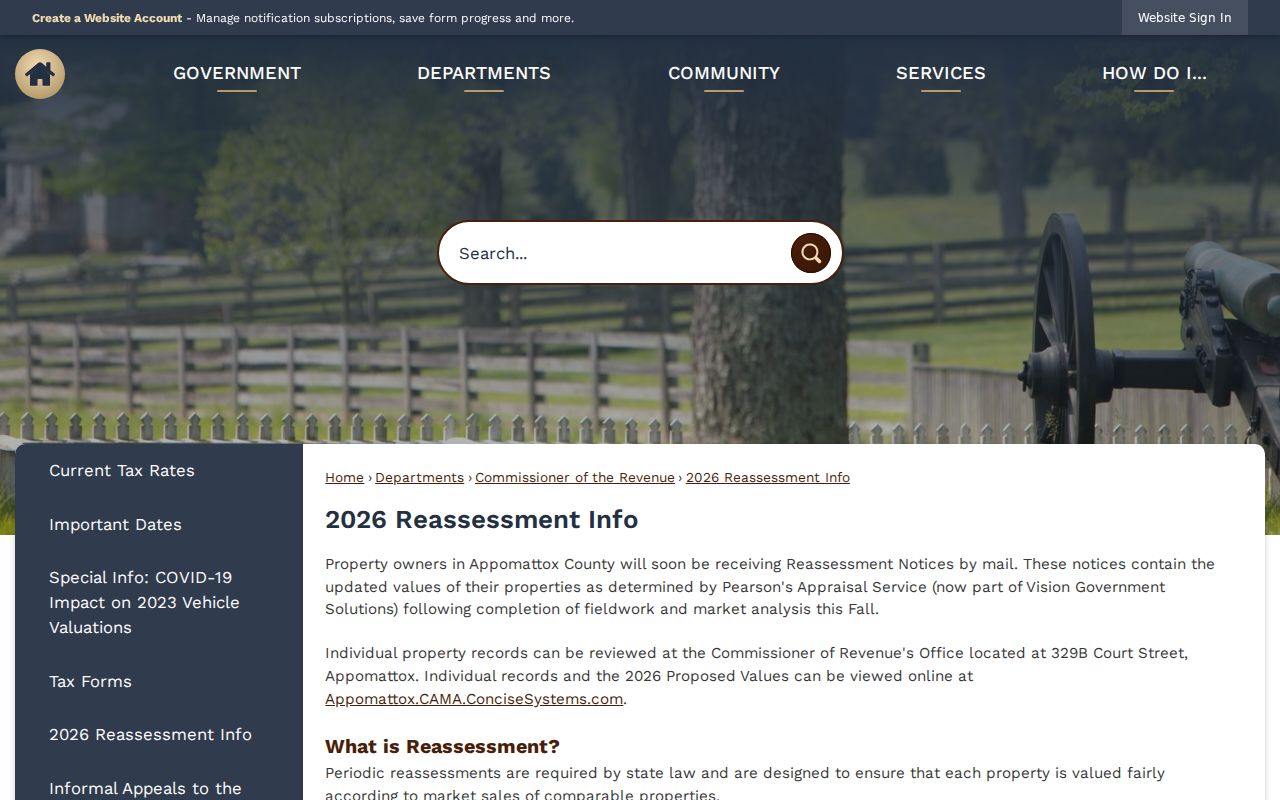
The county's proposed-value page provides the current cycle's review and appeal route.
Looking Up a Tax Bill in Appomattox County
The Treasurer's real-estate search and payment portal is the right tool for checking an Appomattox County tax balance. The CAMA assessment screen is not. The online inquiry runs daily from 7:31 a.m. to 11:04 p.m., with nightly maintenance, and the county lists card and e-check processing charges. Payment systems and due dates shift. Confirm any time-sensitive amount with the Treasurer.
- Open the Treasurer's real-estate inquiry and identify the parcel using the available account or property details.
- Review the current balance and payment status, then note the time of the portal check.
- Compare the parcel with the Commissioner's assessment record; ask about tax relief or land-use classification there.
- For a delinquency or possible lien, contact the Treasurer and check the Circuit Clerk's land index for recorded instruments.
- Assessment
- The county value used in the real-estate tax process.
- Balance
- The amount the Treasurer's inquiry reports as owing at the time checked.
- Tax relief
- A program administered by the Commissioner; verify current eligibility and parcel status with that office.
- Tax lien
- A recorded claim tied to unpaid tax; a balance screen alone does not show release status.
The Treasurer's office sits at 329A Court Street, Appomattox, with weekday counter hours of 8 a.m. to 4:30 p.m. Its phone number is 434-352-5200.
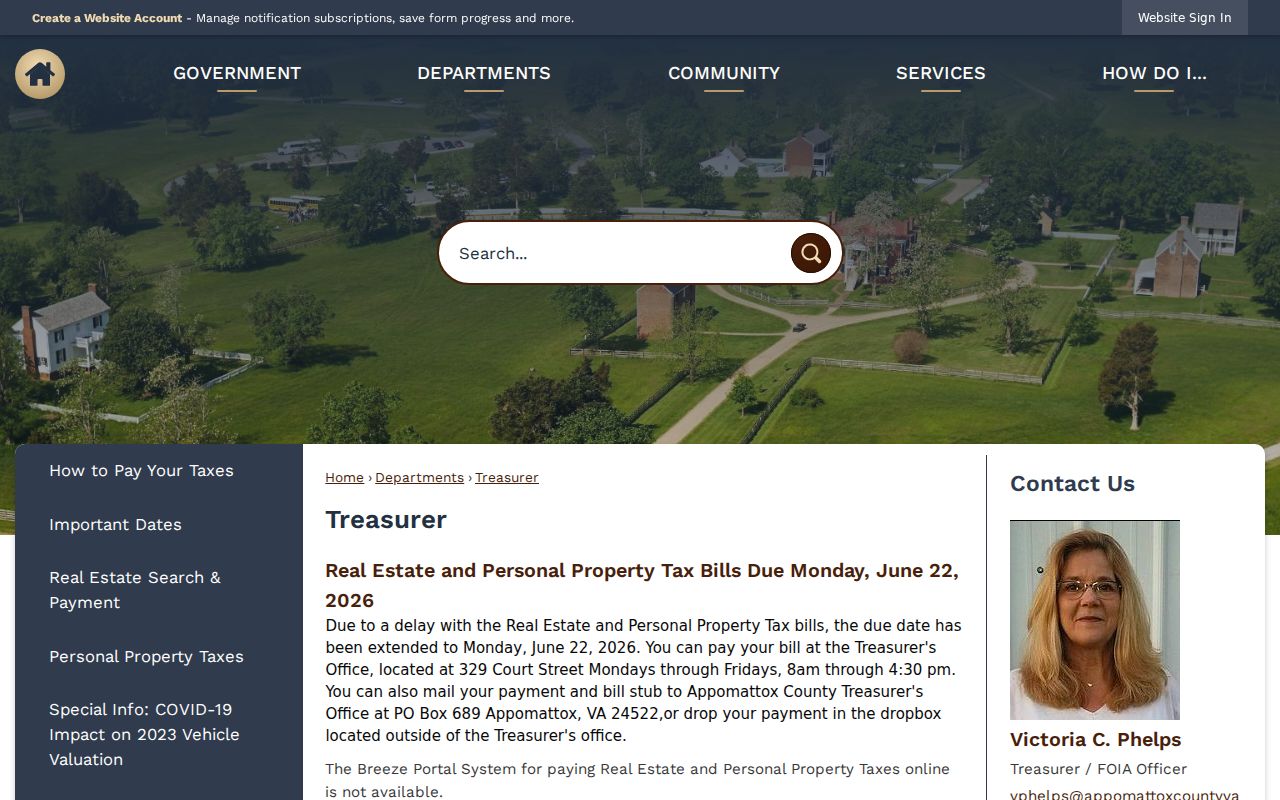
A direct call to this office settles any online balance or payment question quickly.
January 1 Tax Liability in Appomattox County
Appomattox County does not prorate real-estate taxes. Ownership on January 1 fixes liability for the whole year. That rule can surprise a buyer closing later. It can also surprise a seller who has moved before the notice arrives. A private closing statement may split the cost between the parties. But the county still treats the January 1 owner of record as liable for that tax year. Keep three dates distinct: the closing, the January 1 CAMA snapshot, and the Treasurer's bill date. A newly recorded deed can show a new grantee. Yet the year's assessment and tax liability still follow the January 1 record. Ask the Treasurer how a payment posts. Then ask the Commissioner how a later transfer appears on the ownership roll.
Appomattox County Board of Equalization
The 2026 reassessment opened a local review and appeal cycle. County materials say the Board of Equalization may hear appeals after February 1, 2026. A taxpayer can challenge land value, building value, or the total. Evidence should tie to the parcel and the claimed error, lack of uniformity, or fair-market-value issue. A notice of proposed value is not a tax bill. The county publishes an application plus a separate 45-day notice waiver form. That waiver concerns hearing notice rights and cites Code §58.1-3331; it is not a general appeal shortcut. Follow the current county instructions for filing and deadlines, since no single universal final appeal date applies to every parcel.
Before challenging a value, pin down the concern: acreage, a building component, a parcel description, or a comparison with genuinely similar land. Keep the proposed notice and supporting evidence together, and use the same parcel key in any request to the Commissioner. A year-over-year increase alone does not prove an error, because the county's 2026 work combined field review with market analysis. The current route and forms are on the Appomattox County reassessment page.
Appomattox County Tax Relief Records
Appomattox County tax relief starts with the Commissioner of the Revenue. That office administers assistance for elderly or handicapped owners along with land-use programs. Every program sets its own qualifications, application dates, and paperwork. Nothing here lists all of them. A parcel's value alone proves no exemption. So treat any assessment figure as a starting point rather than an answer about relief. Ask the Commissioner directly which program fits. Ask which record supports it. Ask whether the assessment display flags a relief indicator at all.
Zoning and tax classification answer different questions too. County planning material shows most parcels zoned A-1 Agricultural. Yet zoning by itself does not fix a parcel's land-use classification or open the door to land-use treatment. Keep the assessment roll in one corner. Keep the planning map in another corner of any Appomattox County property records review.
Appealing an Appomattox County Assessment
Disagreeing with an appraisal in Appomattox County starts with evidence. Compare the county's figure against facts about the same land, the same buildings, and the same valuation date. The appeal form permits a challenge to the land value. It also allows a challenge to the building value, or the total. Lay out the factual basis for the claim. Attach property records that back it up. A neighbor's sale only helps if the parcel comparison itself is sound.
Appeal window. The 2026 Board of Equalization cycle is published by the county, with hearings available after February 1, 2026. Check the current notice for the parcel-specific filing route and date before submitting an appeal.
Building an Appomattox County Assessment Appeal
Begin with the proposed-value notice. Write down the parcel's map number or PRN, the notice date, and each value listed. The county's Board of Equalization materials cover challenges. A challenge may target land value, building value, or the total. Say plainly which part seems wrong. Then support that claim with parcel-specific evidence. That means a factual correction, a documented condition difference, or comparable property information bearing on fair market value or uniformity.
Pick comparables for use, location, land area, and improvements. Proximity alone is not a virtue. Keep the valuation date in mind throughout. The January 1 assessment does not promise this. A later repair or sale may not appear in the same year's tax roll. Suppose the proposed notice omits the land and building breakdown. Ask the Commissioner whether the live record or the appeal packet carries that component detail.
County materials note that hearings may occur after February 1, 2026. They also include a separate 45-day notice waiver tied to Code §58.1-3331. Read the current instructions before signing any waiver or counting on a particular deadline.
Requesting a County Tax Record
For a balance or payment status, the Treasurer's inquiry is the direct route. Older bills, payment posting, a tax account question, or any record not on the portal goes to the Treasurer at 329A Court Street, 434-352-5200. The Commissioner at 329B Court Street, 434-352-7450, holds the assessment and tax-relief record. Valuation questions belong to the Commissioner; amounts due belong to the Treasurer.
When an existing nonexempt public record is not online, a Virginia FOIA request should name the office that holds it and specify the parcel, years, and records sought. The County FOIA Officer can be reached at 153A Morton Lane, PO Box 863, Appomattox, VA 24522, 434-352-2637, or FOIA@appomattoxcountyva.gov. The law allows five working days for a response, with limited extension options, and the county may charge actual search and duplication costs. No office must create a new calculation or report it does not maintain.